The short version
We’re a small field service software company. We don’t have an SEO agency or a content team. Google’s new Generative AI report in Search Console shows our pages appearing in AI Overviews and AI Mode 4,520 times in the last 28 days — up from 56. Here’s the proof, what the report actually measures, what we did, and the one popular tactic we don’t give credit to.
- The report is new: announced June 3, 2026, rolled out to everyone in August. Impressions only — no clicks, no queries.
- What worked: picking one narrow lane, answer-first posts backed by primary sources, fixing our own technical mistakes, and earning links nobody paid for.
- What Google says doesn’t matter: llms.txt. We have one. Google says Search ignores it.
- For local trades: the fundamentals that get you recommended are boring, and they work.
On this page
Every trades owner has heard some version of this in 2026: “Customers don’t Google anymore, they ask ChatGPT.” It’s overstated — but it’s not wrong that more people now get their first answer from an AI summary, and the businesses those summaries cite get the trust.
Most advice about getting into those answers comes from agencies selling it. This isn’t that. This is what happened on our own site, with the Search Console screenshot to prove it, including the things that didn’t matter.
The receipts
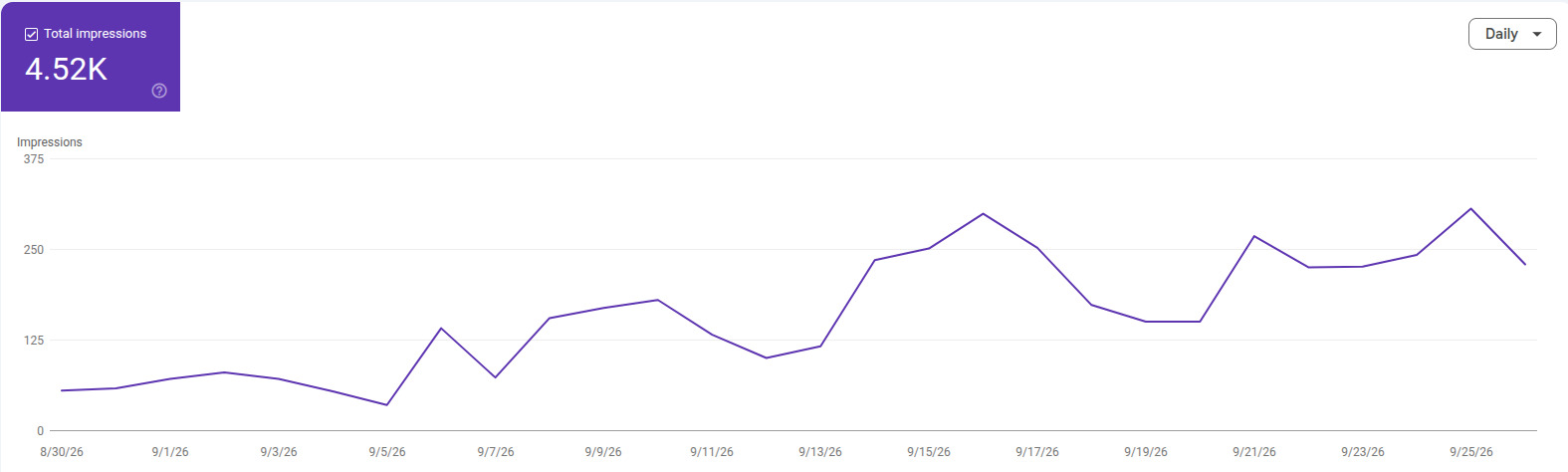
The AI numbers didn’t move alone. Over the same summer:
| Metric | Early summer 2026 | Late September 2026 |
|---|---|---|
| Google AI impressions (28 days) | 56 | 4,520 |
| Organic search clicks | ~2 a day | 16–20 a day |
| URLs earning impressions | 58 | 117 |
| Blog posts published | ~15 | 85 |
| Ahrefs Domain Rating | 17 | 19 |
Third-party tracking also started picking up citations of our pages in Microsoft Copilot, Perplexity, ChatGPT, and Gemini — Copilot most often. Those are small numbers, but a year ago the number was zero.
What Search Console’s new Generative AI report actually shows
Until this summer, AI Overview impressions were mixed into the regular Performance report with no way to separate them. Google announced dedicated Generative AI performance reports on June 3, 2026, as a beta, and finished rolling them out to all Search Console properties on August 11. Here’s what’s in it:
- Surfaces: AI Overviews and AI Mode in Search, with a separate Discover view.
- Metric: impressions only. No clicks, no queries, no click-through rate, no average position.
- Breakdowns: pages, countries, devices, and dates.
- History: data starts on May 18, 2026. Nothing earlier.
How to read it without fooling yourself
- Clicks still happen — they’re just elsewhere. A click on your link inside an AI Overview or AI Mode counts in the main Performance report, not this one.
- It’s not new traffic. These impressions were already in your overall numbers. What’s new is being able to see them separately.
- AI Mode inflates counts. Each follow-up question in AI Mode counts as a new search.
- Use the Pages tab. It tells you which pages Google’s AI trusts on your site — which is where to invest next.
Google has also been testing a control in Search Console that lets sites opt out of appearing in AI features. For most local businesses, we think staying visible is the better trade.
What we actually did
None of this is a trick. It’s the same list, done consistently, for months.
1Picked one narrow lane
We didn’t write about “business tips.” We wrote about licensing, insurance, and compliance for specific trades: locksmiths, garage door, electricians, plumbers, handymen, alarm installers, mobile mechanics. State by state. When a site covers one area deeply, it becomes the obvious source to cite for that area.
2Wrote answer-first pages
Every post opens with the short answer. Then the detail: state-by-state tables, clear headings, FAQ sections, and the specific number a reader came for. AI summaries lift clean, specific answers. Our locksmith licensing guide gets so much section-level attention that Search Console reports its individual sections as separate URLs.
3Went to primary sources — and corrected the internet
We read the statutes, board rules, and agency pages instead of rewriting other blogs. That turned up outdated numbers everywhere: handyman caps that had changed, fee schedules that had gone up, Florida’s roofer insurance floor being quoted with the general contractor number. Our garage door licensing guide reached the top of Google for its main query on the strength of getting details right that other pages got wrong.
4Published consistently — and noticed when we stopped
We went from about 15 posts to 85. When we took a month off during a move, clicks fell by about half. When publishing resumed, new posts started showing up in Google within hours instead of weeks.
5Rewrote the pages already working
We went back to our top 20 posts, the ones with impressions, and made them tighter, more current, and more specific. Not longer. Better.
6Fixed our own technical mistakes
We found meta descriptions with broken quote marks across several high-impression pages. Google was ignoring them and writing its own snippets. Fixing them was the single fastest win of the summer.
7Linked the cluster together
Licensing posts link to insurance posts link to state guides link back. That tells search systems which pages belong together, and it keeps readers on the site longer.
8Earned links we didn’t ask for
Other businesses started linking to our guides because the guides were useful, including a field service software site and a locksmith company. A competitor who ranked just below us emailed asking for a link. We bought zero links.
9Made our brand unambiguous
“Vortech” is also a supercharger company. We kept our name, description, and category consistent everywhere so search and AI systems stop mixing us up with anyone else.
The llms.txt question: we have one, and we don’t credit it
llms.txt is a text file some sites add to describe themselves to AI systems. It’s been sold hard as the key to AI visibility. We added one in September to help separate our brand from similarly named companies.
But here’s what Google says: its Search documentation now states that you don’t need machine-readable files, AI text files, markup, or Markdown to appear in Google Search — including its generative AI features — because Google Search doesn’t use them, and that maintaining llms.txt files won’t harm or help your visibility. Source: Google Search Central: AI features and your website
Since the report in this post measures Google’s AI features, we’re not going to pretend llms.txt drove it. We keep ours because it costs nothing and other AI systems may read it. If someone sells you llms.txt as the fix for Google’s AI, ask them for a source.
Google’s actual guidance is almost boring: its AI features draw on the same search systems as regular results. Helpful, crawlable, well-structured pages that earn trust. That’s the whole game.
Why AI picked these pages
The Pages tab in our Generative AI report is dominated by the same kind of page: licensing and compliance guides. Looking at what they have in common:
- They answer a specific question people actually ask: “Do I need a license to be a locksmith in Texas?”
- They contain facts you can lift: a dollar threshold, a fee, a deadline, a statute number.
- They cite primary sources — state boards, statutes, agencies.
- They’re current, with clear dates and 2026 updates.
- They’re the best page on a narrow topic, not the tenth-best page on a broad one.
Our software comparison posts — “best dispatch software for X” — get far fewer AI impressions. Those queries are crowded and commercial. Trustworthy reference content is what gets cited.
Mistakes that cost us
- Stopping. A month without posts cut our clicks roughly in half. Consistency compounds; gaps reset momentum.
- Broken meta tags. A copy-paste error left quote marks broken on several top pages for weeks. Check your source, not just your CMS preview.
- Stale facts in our own posts. Researching new posts turned up outdated numbers in older ones. We fix them as we find them — a site that corrects itself is a site worth citing.
- Chasing hacks. Time spent on AI-specific tricks would have been better spent writing one more great page.
Want This for Your Trade Business?
Vortech Sites & SEO builds fast websites for trades businesses and runs the same white-hat playbook from this post: accurate listings, helpful content, clean technical SEO, and no bought links. No retainers you can’t read.
Getting a local trades business recommended by AI
Our case is a software company publishing guides. If you’re a garage door or locksmith company, the question you care about is different: when someone asks an AI assistant for a garage door tech near them, does your business come up? The fundamentals:
- Google Business Profile, complete and accurate. Correct category, service area, hours, phone, services, photos. Google’s local results lean on it heavily — and a wrong address or suspended profile makes you invisible. See our guide to free business listings for trades.
- Same name, address, and phone everywhere. Your website, Google, Bing, Apple, Yelp, industry directories. Inconsistency makes you look like two businesses — or none.
- Bing Places. Microsoft’s Copilot is built on Bing’s data, and Copilot was our most frequent AI citer. Most trades businesses never claim their Bing listing. See Google Ads vs Bing Ads for trades for why Bing matters more than people think.
- Real reviews, steadily. Recent, specific reviews are trust signals for people and for systems. Handle the bad ones well — here’s how.
- A website that says clearly what you do and where. A page per core service, the cities you serve, your license numbers, and answers to the questions customers actually ask.
- Helpful content in your niche. A locksmith who publishes the best explanation of rekey vs replace in their city is building exactly what AI systems cite. Our locksmith SEO long-game guide walks through it.
- Don’t block the crawlers you want. Check your robots.txt and security settings aren’t blocking search engines or the AI search crawlers you want to be found by.
Copy-this checklist
- Open Search Console → the Generative AI report. Note your 28-day baseline.
- Check the Pages tab. Those are the pages AI already trusts — improve them first.
- Pick one narrow topic your customers ask about and cover it better than anyone.
- Lead every page with the short answer, then back it up with specifics and sources.
- Publish on a schedule you can keep. Consistency beats bursts.
- Rewrite your top-performing pages every few months: current, tighter, more specific.
- View source on your key pages and check titles and meta descriptions are valid.
- Link related pages together.
- Claim and complete Google Business Profile, Bing Places, and Apple Business Connect.
- Make your business name, address, and phone identical everywhere.
- Ask for reviews after every good job.
- Skip the hacks. If a tactic’s only selling point is “AI,” ask for a source.
The bottom line
We didn’t find a secret. We picked a narrow topic, researched it better than the pages already ranking, published consistently, fixed our own mistakes, and let other sites decide we were worth linking to. Google’s AI features noticed the same things Google Search noticed — which is exactly what Google says they do.
The new Generative AI report doesn’t tell you how to get cited. It tells you whether what you’re already doing is working. For us, 56 became 4,520. The playbook is above.
Get Found by Customers — and the AI They Ask
Fast trades websites, accurate listings, and white-hat SEO from the team that built this blog. Vortech Sites & SEO.
FAQ
What is the Search Console Generative AI report?
A Search Console report that isolates how often your pages appear in Google’s AI Overviews and AI Mode, with a separate Discover view. Google announced it on June 3, 2026 as a beta and finished rolling it out to all properties in August. Data starts May 18, 2026, broken down by page, country, device, and date.
Does the Search Console Generative AI report show clicks?
No — impressions only, with no clicks, queries, CTR, or position. Clicks on links inside AI Overviews and AI Mode still count, but in the main Search Performance report.
Does llms.txt help you get cited in Google AI Overviews?
No, according to Google. Its documentation says Search, including its generative AI features, doesn’t use AI text files like llms.txt, and that maintaining one won’t harm or help visibility. We have one, but we don’t credit it for our Google numbers.
How do I get my business recommended by AI assistants?
Complete and accurate Google Business Profile, consistent name, address, and phone everywhere, a Bing Places listing, steady genuine reviews, a crawlable site with clear service and location pages, and helpful content that other sites link to and AI can cite.
How long did it take Vortech Pro to get cited by AI?
The blog launched in spring 2026 and clicks stayed small for months. The inflection came in September, after 80+ posts, rewrites of top pages, and meta tag fixes. Our 28-day AI impressions went from 56 to 4,520.
Do backlinks matter for AI citations?
Google says its AI features draw on the same systems and fundamentals as regular search, so the signals that help pages rank — including links from relevant sites — help them get surfaced. Our growth tracked closely with natural links to our licensing guides.
Should I block my site from AI Overviews?
Google has been testing a Search Console opt-out for AI features. For most local trades businesses, being cited is visibility with customers who are actively researching, so opting out usually costs more than it saves.
Can a small business really do this without an agency?
Yes. Everything here was done in-house by a very small team. It takes consistency and patience more than budget. If you’d rather hand it off, Vortech Sites & SEO builds sites and runs white-hat SEO for trades businesses.